
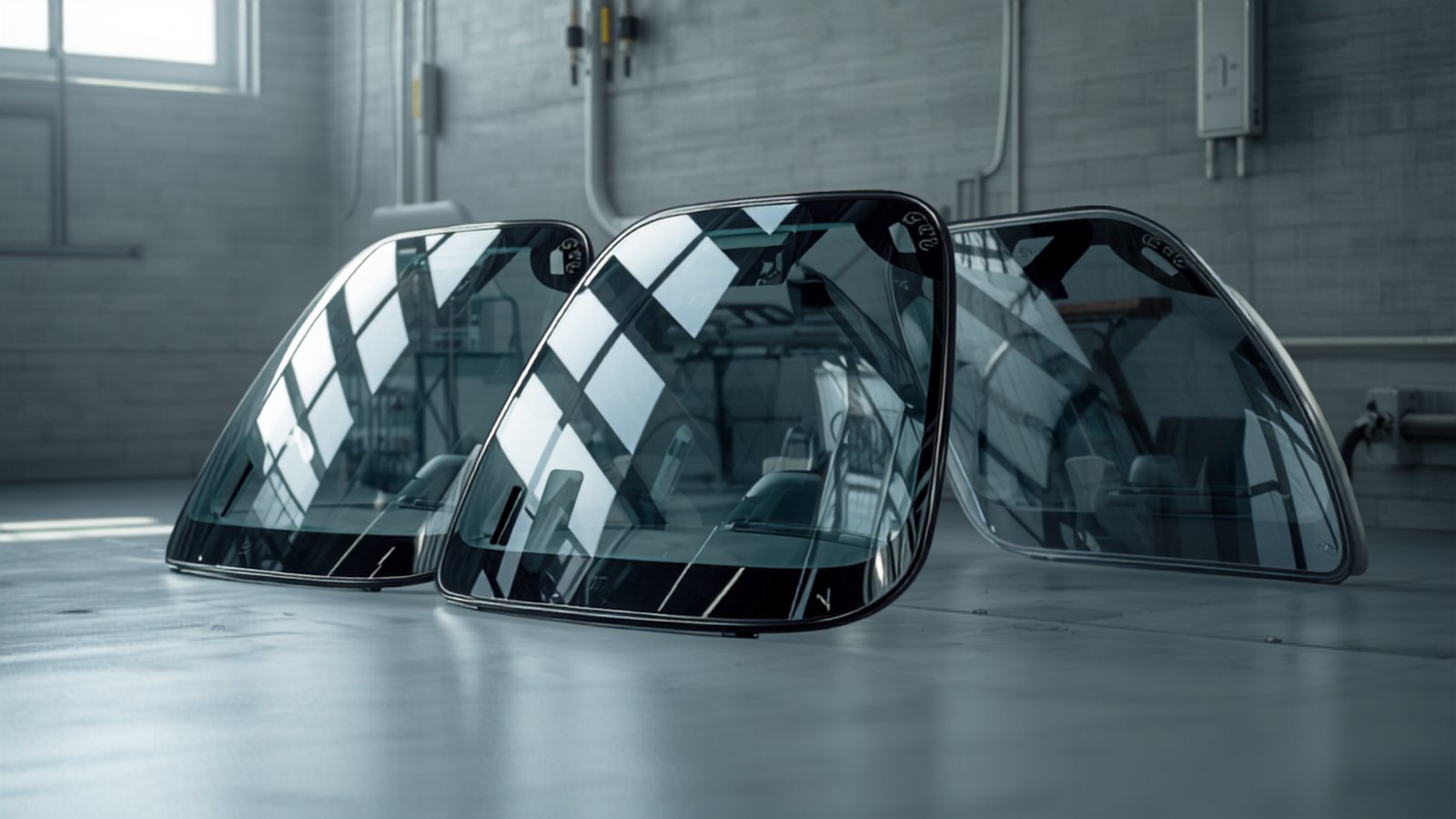
Somewhere in the first phone call, the shop will ask a question you probably weren’t ready for: “Did you want OEM glass, or aftermarket?”
It sounds like a trick. Say OEM and the price jumps a few hundred dollars. Say aftermarket and you spend the drive home wondering if you just cheaped out on the thing between your face and the highway. Neither is quite right — and the honest answer depends on your car, not on the glass industry’s vocabulary.
Here’s what the three tiers actually mean, and how to decide without a chemistry degree.
The three tiers, translated
OEM (Original Equipment Manufacturer) glass is made by the same supplier that built your car’s original windshield, to the automaker’s own blueprint, with the automaker’s logo etched in the corner. It typically comes through the dealer network, and it’s the closest thing to what rolled off the assembly line — because in most cases, it is what rolls off the assembly line.
OEE (Original Equipment Equivalent) glass often comes from those same manufacturers — names like Pilkington, Saint-Gobain, AGC, Fuyao, and Carlex supply both the factories and the replacement market — built to match the original specifications, minus the automaker’s branding. Same recipe, plainer label, noticeably lower price.
Aftermarket glass is made by third-party manufacturers to fit your vehicle. Here’s the part most drivers never hear: because automakers don’t share their blueprints, aftermarket makers reverse-engineer the glass from measurements. Good aftermarket glass lands very close to original. Lesser aftermarket glass can be slightly off in thickness, curvature, or optical clarity — differences you’d never notice holding the two panes side by side, but that can matter in specific situations we’ll get to.
One reassurance before anything else: all three tiers are legal and crash-tested. Every windshield sold in the U.S. must meet the same federal safety standard (FMVSS 205) for impact resistance and clarity. The standard is a floor, though, not a ceiling — and the tiers differ in how far above that floor they sit.
When OEM is genuinely worth it

There are cases where the premium buys something real:
Your windshield is part of a display. Head-up display (HUD) systems project onto a windshield with a special wedge-shaped inner layer that keeps the image from ghosting. Aftermarket HUD-compatible glass exists but isn’t available for every model, and glass without the wedge will give you a blurry double image every time you drive. If you have HUD, OEM (or a verified HUD-spec OEE) isn’t a luxury — it’s the spec.
Your car is unusually quiet on purpose. Acoustic glass uses a sound-damping interlayer with a specific thickness. Some aftermarket panes approximate it; some skip it. If you bought the car partly for the serene cabin, generic glass can quietly give some of that back to the road.
Your safety systems watch the road through the glass. Lane-keeping and emergency-braking cameras look through a small zone of the windshield, and they’re sensitive to optical distortion there. Any tier can calibrate successfully — but when a calibration repeatedly fails, installers will tell you the fix is often swapping lower-grade glass for OEM or high-quality OEE. Each failed attempt costs another appointment.
The car is nearly new, leased, or headed for resale. Some lease-return inspections and picky buyers look for the automaker’s logo in the corner. If the etching matters to your exit plan, it matters.
When OEE is the smart middle
For most drivers with a camera-equipped vehicle — which is nearly everyone driving something built in the last eight years — OEE is the quiet sweet spot. You’re frequently getting glass from the same production ecosystem as the original, at a meaningful discount, with the optical quality that keeps calibrations clean. When a good shop says “we’ll use OE-equivalent glass from the original supplier,” this is what they mean, and it’s a perfectly good answer.
When aftermarket is completely fine
If you drive an older vehicle with no camera, no HUD, and no acoustic package — say, a pre-2015 sedan whose windshield is just a windshield — quality aftermarket glass from a reputable maker is a sensible, safe choice. The reverse-engineering concerns matter most where precision optics are involved; a simple windshield on a common model has been made by aftermarket suppliers thousands of times, and they’ve long since perfected the fit.
What insurance will pay for
Most policies cover “like kind and quality” — which insurers generally read as OEE or aftermarket. Some policies offer an OEM endorsement; some carriers will pay for OEM if you ask and the vehicle warrants it; and you always have the option of paying the difference yourself. If the OEM question matters to you, raise it when you file the claim, not when the installer is standing in your driveway.
Four questions that settle it
You don’t need to memorize glass metallurgy. You need four answers from the shop:
- “What brand of glass are you quoting, and is it OEM, OEE, or
aftermarket?” A good shop answers instantly and specifically.
Vagueness here is your cue to keep shopping. - “Does my car have HUD, acoustic glass, or a heated
windshield — and does this glass match those features?” Your
VIN tells the shop exactly what the factory installed. Make sure the
replacement matches it. - “If my car needs calibration, is it included, and what
happens if it doesn’t pass?” You want calibration done,
documented, and covered if the first attempt fails. - “What’s the warranty on the glass itself?”
Reputable suppliers at every tier stand behind their product against
defects, leaks, and stress cracks.
The right glass isn’t automatically the one with the logo, and it isn’t automatically the cheapest pane that fits the hole. It’s the one that matches what your car was built with — asked for out loud, and confirmed in writing.
